

Site Search
Search within product
第737号 2022(R04).01発行
Click here for PDF version
§ Responsibility of fertilizer manufacturers to contribute to agriculture
Jcam Agri Co.
常務執行役員 勝呂 俊行
§ Sakai Farm built by our predecessors (No.3)
〜120 Years of History - A Look Back at the Transition of Varieties, Fertilizers, etc. as Reflected in the Transcripts
JA Fukui Sakai Farm
前 農場長 長谷川 彰
No § Soil - No. 8
よい土の条件 化学的性質−その3
適度に含まれる作物の養分
Jcam Agri Co.
北海道支店 技術顧問
松中 照夫
Fertilizer Manufacturers' Responsibility to Contribute to Agriculture
Jcam Agri Co.
常務執行役員 勝 呂 俊 行
Happy New Year!
令和4年の年頭にあたり,本誌「農業と科学」をご愛読いただいております皆様に一言ご挨拶申し上げます。
一昨年来,新型コロナウイルスのパンデミックによる世界的な行動制限の中,我々の生活に多大な影響が出ております。今だ(10月現在),一人一人の感染予防の継続が余儀なくされていますが,ワクチンの普及と治療薬の開発が進められ,終息に向かう光が見えて来たところかと思います。
On the other hand, there have been many outbreaks of unknown viruses in the past, and it is said that the cause of these outbreaks is the increase in contact opportunities between humans and natural animals as they have grown closer to each other due to deforestation to secure resources for food production and other needs in response to population growth. The United Nations estimates that the world population will reach 10.9 billion by 2100, and the University of Washington estimates that it will peak in 2064 and reach 8.8 billion by 2100. In any case, the world population is expected to increase from the current level. Therefore, in order to control the contact opportunities mentioned above, it is necessary to increase food production per area (= efficient production of agricultural products), and we believe that we can make a contribution to this.
Last year, Mr. Yoshiro Manabe was awarded the Nobel Prize for his "global general circulation model" developed in the 1960s. The reason for the award was that "it has become the basis of modern climate research. The news is so full of stories about climate change that not a day goes by that we do not hear about it. Globally, extreme high temperatures in southern Europe, flooding in central Europe, and extreme high temperatures and drought in the southwestern United States occurred. We are reminded that climate change is becoming more severe with each passing year.
この様な地球規模の異変に対して,金融界でもESGの概念で投資判断することが広まって来ており,この後押しも相まって,SDGsへの取組み・貢献が企業の責務であることが世界共通の認識となって来ています。弊社では約40年前に肥料成分を樹脂被覆することにより肥料成分の溶出を高精度で制御するコーティング肥料を開発・上市し,環境負荷低減,農作業の省力化に貢献してまいりました(SDGsの開発目標では2,9,13,15に貢献)。一方,開発目標の14「海の豊かさを守ろう」では,肥料成分溶出後の被膜殻が海洋に流出することによるネガティブな影響を与えております。この問題に対し弊社では以前より,①被膜中の樹脂量低減,②圃場からの流出を抑制させる技術開発,③自然環境で完全分解させる技術開発を進めてまいりました。
At present, we have launched a product with a progressively reduced resin ratio for (1) and a product that accelerates the collapse of the film in the field and suppresses outflow from the field for (2), but have yet to develop a technology to completely decompose the film shell while maintaining the advantages of (3) above. We will continue to promote research and development that contributes to the efficiency of food production as well as to the SDGs Goal 14. Finally, I would like to conclude this New Year's greeting by expressing my sincere gratitude for your continued patronage of this issue of "Agriculture and Science" and my best wishes for your happiness and prosperity in the coming year.
Sakai Farm built by our predecessors (No.3)
〜120 Years of History - A Look Back at the Transition of Varieties, Fertilizers, etc. as Reflected in the Transcripts
JA Fukui Sakai Farm
前 農場長 長谷川 彰
V. Heisei Era (1989 - 2008)
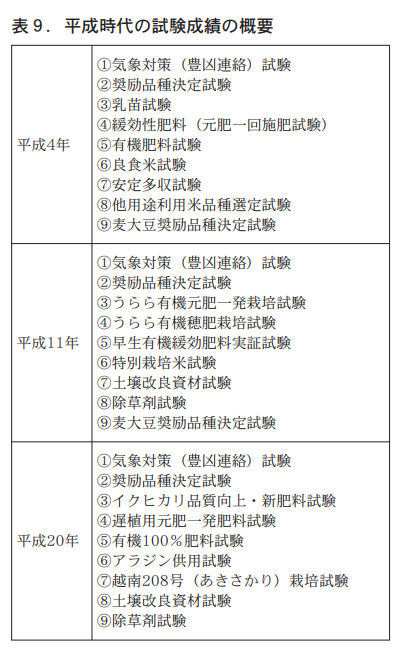
昭和41年から63年の全国平均収量は461kg(福井県473kg)と大幅に増加しコメ不足から過剰時代になりました。平成4年には,品種,気象対策試験(豊凶考照試験)に加え,良質米栽培技術の確立・コシヒカリ有機栽培・乳苗移植の実証・多収品種の栽培技術の確立などに取り組んでいます。
In fertilizer trials, the first one-shot application of a slow-release fertilizer is being tested. In addition, emphasis has been placed on improving the quality and taste of rice by testing a small amount of primary fertilizer and an emphasis on ear fertilizer for Koshihikari rice, as well as a dedicated primary fertilizer and additional fertilizer for Koshihikari rice. In 1995, the Food Law was enacted and the liberalization of rice distribution began. Since 1999, in addition to variety and weather control tests, organic slow-release fertilizer tests have been conducted on Koshihikari rice, including a single-shot and partial application organic fertilizer system developed for Koshihikari, and a special rice cultivation test, with a stronger awareness of the consumer in terms of taste, safety, and security. In particular, in order to promote the branding of Hanasaki Fukui Agricultural Cooperative's rice, we worked on the development of an organic, one-shot, organic fertilizer and promoted it as part of the "Urara Series. This was a notable effort by a single agricultural cooperative at the time.
In 2005, the Food, Agriculture and Rural Areas Basic Law was enacted, and the following year, the Organic Agriculture Promotion Law was enacted.
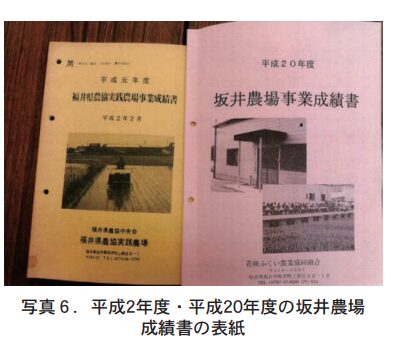
平成20年には,品種,気象対策試験(豊凶考照試験)に加え,高品質のコシヒカリを目指した遅植・肥料試験,さらに低コストを目的としたアラジン肥料や新品種あきさかりの栽培試験を実施しています。平成元年から20年の全国平均収量は507kg(福井県508kg),昭和41年から63年の平均収量461kg(福井県473kg)と比べ増加しました。平成20年の米価は13,851円/俵で,昭和63年の米価16,743円/俵と比べ大きく減少しています。
(1) Outline of variety testing, etc.
(Koshihikari, Hanaechizen, Akisakari)
この時代の品種試験は,早・晩生品種を対象に実施し,平成元年は,早生『フクヒカリ』,晩生『日本晴』などを標準品種とし『越南140号』『越南146号』『ヤマヒカリ』等8品種を栽培しています。平成5年における福井県の主な品種は,『コシヒカリ』『ハナエチゼン』『フクヒカリ』『日本晴』となっています。平成11年には,『ハナエチゼン』『キヌヒカリ』『日本晴』を超える品種をめざし,『愛知101号』『越南171号』『北陸178号』『北陸179号』など13品種を作付しています。
平成20年には,『ハナエチゼン』『コシヒカリ』を標準品種とし『越南208号』『越南211号』など6品種を作付しています。『越南208号』は『あきさかり』と命名されました。平成20年の福井県の主な品種は,『コシヒカリ』『ハナエチゼン』『イクヒカリ』となっています。
(2) Outline of fertilizers, etc. (dissemination of all-base one-shot fertilizers)
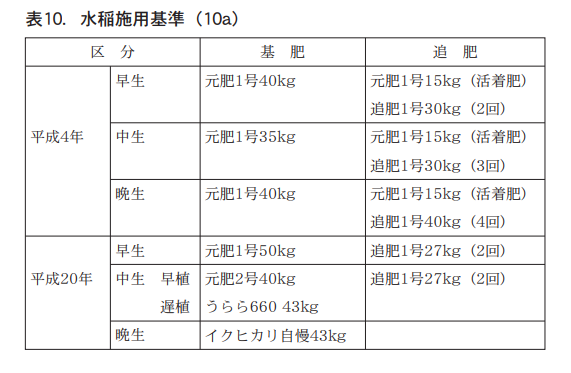
The conventional fertilizer for the first half of the Heisei era (1989 to 1999) was No. 1 primary fertilizer and No. 1 secondary fertilizer, and the fertilizer rate for Koshihikari was 10 kg/10a in terms of N component.
In 2008, the first fertilizer No. 2 and the first additional fertilizer No. 1 were used, and for Koshihikari rice, URARA 660 was used as the all-base one-shot fertilizer. One-shot fertilizers are becoming more widespread due to the increasing number of dual-use farmers and from the viewpoint of labor saving. Urara" means "we" in the Fukui dialect. In 2008, the amount of fertilizer applied to Koshihikari rice was 8 kg N/10a for conventional fertilizer and 7 kg N/10a for late-planting fertilizer, a decrease from the previous year. The fertilizer cost per 10a in 2009 was 8,655 yen. The average price of rice in relative trade was 12,942 yen per bale, and the ratio of fertilizer to rice income was about 8%.
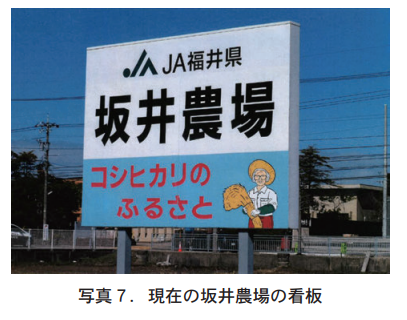
VI. Heisei and 2021 Era (from 2009)
平成22年から,気象対策試験コシヒカリの田植えは,出穂後の気温が高いと未熟粒,胴割粒が多発するため,長年続いてきたゴールデンウィークから5月17日に実施しています。肥料試験については,早中晩生の主要品種に対し有機20%のエコ肥料試験を行っています。
これらの背景として,厳しい産地間競争に対応するため県下挙げての品質向上等を目的としたコシヒカリの5月(さつき)半ばの適期田植え(5月中旬以降)や福井米生産者のエコファーマー化の推進がありました。田植時期等の見直しにあたっては,育苗センターの運営や肥料の開発など多くの課題がありましたが,多くの方の協力により福井の5月前半の風景は一変しました。
In 2013, a five-year review of rice production adjustment was announced from the viewpoint of respecting farmers' autonomy, and since then, the development of each prefecture's own brand of rice has accelerated.
Although the Major Agricultural Seeds Law, which is the cornerstone for breeding varieties in public institutions, was repealed in 2008, Fukui Prefecture has enacted its own ordinance.
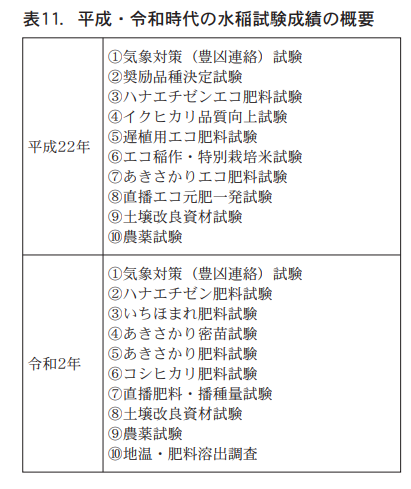
令和2年には,新たな省力化技術として注目されている密苗試験やハナエチゼン,コシヒカリ,あきさかりを対象に温暖化・生育ステージの早期化に対応した品質・収量向上を目的とした肥料試験が主な内容となっています。
この時代の平均収量は531kg(福井県520kg)と平成前期に比べやや増加しました。高齢化・人口減等による米消費量が減少しコメの過剰基調が一段と強まっています。
(1) Outline of variety testing, etc. (Birth of Ichihomare)
In 2010, five varieties, including "Echigo-Tsumari No. 211" and "Echigo-Tsumari No. 221," were grown with "Hanaechizen" as the standard variety. The main varieties planted in 2011 are "Koshihikari", "Hanaetizen", "Ikuhikari", and "Akisakari". In 2014, Sakai Farm was commissioned by the prefectural government to conduct a trial to determine which varieties to promote. Since 2015, 10 lines have been tested in cooperation with the Fukui Prefectural Agricultural Experiment Station with the goal of creating a post-Koshihikari variety, and Ichihomare was born in 2017.
The main varieties in Fukui Prefecture in 2020 were Koshihikari, Hanaetizen, Akisakari, and Ichihore, with Koshihikari accounting for about 48% of the total.
(2) Outline of fertilizers, etc. (dissemination of eco-based one-shot fertilizers)
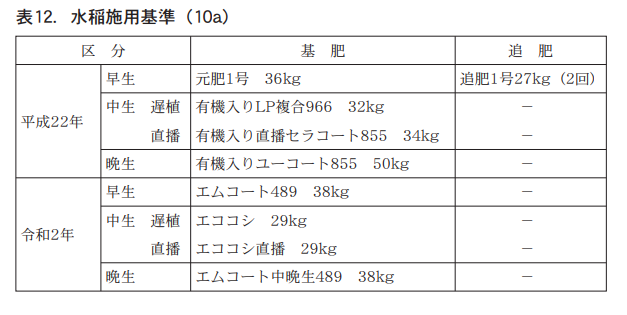
平成22年の施用基準を見ると,早生には,元肥1号,追肥1号が,中晩生のコシヒカリ,あきさかりでは,有機入りLP複合966等の基肥一発肥料が,平成24年からは,早中晩生品種全てに有機入り基肥一発肥料が供されています。令和2年時点では,コシヒカリ,いちほまれがエコ基肥一発肥料,ハナエチゼン,あきさかりは化成の基肥一発肥料が慣行肥料となっています。
The amount of fertilizer applied to Koshihikari in 2020 was 6 kg N/10a, half of the amount applied in the past when the amount was higher, in order to emphasize eating quality and taste. Currently, a review of ear fertilizer is under consideration to cope with the trend toward high temperatures during the ripening period.
According to the Annual Report of Crop Statistics, the fertilizer cost per 10a in 2009 was 7,266 yen, and the rice price (average price in relative trade) was 15,683 yen per bale, which means that fertilizer cost as a percentage of rice income was about 61 TP3T.
Conclusion
From the fertilization standards of the Meiji Era (120 years ago), which would be unthinkable today, there were soybean meal from the continent and kipper meal from Hokkaido, soybean meal and ammonium sulfate in the Taisho Era, lime superphosphate, lime nitrogen, etc. in the Showa Era, compound fertilizer after the war, and organic fertilizers, one-shot fertilizer, etc. in the Heisei Era. In the Meiji and Taisho periods, the majority of varieties were local species such as Shirachinji and Oba. In the first half of the Showa period (1926-1989), Nohbayashi No. 1 and Fukui Ginbouzu became popular, followed by Nohbayashi No. 23, Hounenwase, Manryo, Nihonbare, and Koshihikari in the postwar period, and finally the current Hanaechizen, Koshihikari, Akisakari, and Ichihomare. During this period, the yield per 10a of paddy rice has remarkably improved.
The testing issues have also shifted from fertilizer and variety testing to ensure yield, to the pursuit of good quality rice, good taste, and labor saving (one-shot fertilization method, direct seeding, etc.).
I am truly humbled by the efforts of our seniors who have devoted themselves to tireless research and hard work during this period, as well as the cooperation of related organizations.
The current era is known as the "Warring States Period" of rice production, and all rice-producing regions have entered an era in which they are struggling to survive. Will the rice production in 2025 head toward an era of brand-name rice, low-cost commercial rice, and rice for export?
In addition, the world is facing a number of issues such as hunger caused by population growth, global warming, and reduction of carbon dioxide emissions, as well as diversifying market needs and development of low-cost materials.
Currently, the government is working to promote the spread of smart farming technology and the Green Food System Strategy. Under these circumstances, I think it is more important than ever before for farms of farmers and farm management advisors to tackle issues that are more relevant to the field and contribute to raising farmers' income. I would like to back up Sakai Farm as a base for agricultural promotion that will be more useful to everyone than ever before.
reference data
●坂井農場の80年(JA)
●坂井農場100年史(JA)
●福井県における水稲新品種育成事業の経過とその成果(福井県)
●農業試験場100年史(福井県)
No Soil - No. 8
よい土の条件 化学的性質−その3
適度に含まれる作物の養分
Jcam Agri Co.
北海道支店 技術顧問
松中 照夫
Of the four conditions for good soil for crop production, we have discussed three so far. This month, we begin the fourth and final condition. That is, we will consider the chemical properties of the soil, i.e., "the soil must contain an adequate amount of nutrients for crops. The question here is what kind of nutrients are contained in crops and how much are they in moderation.
1. 17 nutrients essential for plants (crops)
We humans obtain the nutrients we need from food, such as carbohydrates, fats, proteins, vitamins, and minerals (inorganic substances). In the same way, plants (crops are included in plants) also need nutrients, which we call nutrients.
とくにアーノンとスタウト(1939)は,次の3つの条件を満たした養分を,植物の生育になくてはならない必須養分と定義することを提案した。現在はそれが受け入れられている。
その3つの条件とは,
①その養分がなければ植物は生育し続けることができないこと(必要性),
②その養分がなければ固有の欠乏症があらわれ,その症状を正常に回復させる方法はその養分を与えること以外にないこと(非代替性),
③その養分が植物の栄養に直接的な役割をはたしていること(直接性)
である。直接的な役割とは,その養分が植物体を構成する成分であるか,あるいは,体内での生理的な反応に直接かかわりをもっているという意味である。
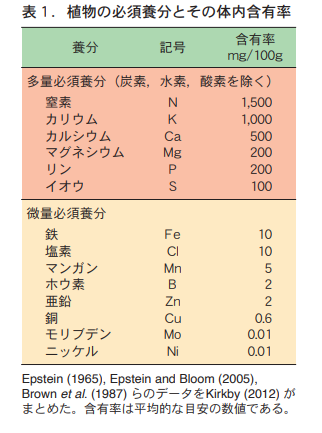
現時点で必須養分は以下の17個である。必須養分のうち植物が比較的多量に要求する養分を多量必須養分といい,炭素,水素,酸素のほかに,要求量の多い順に,窒素,カリウム,カルシウム,マグネシウム,リン,イオウの9つである(表1)。炭素,水素,酸素は,大気中の二酸化炭素や酸素,さらに,土の中の水(H2O)から吸収できるので,地球上で植物が生育するかぎり不足することはあまりない。したがって,多量必須養分として重要なのは窒素からイオウまでの6種類である。必須養分で残りの8つは,鉄,塩素,マンガン,ホウ素,亜鉛,銅,モリブデン,ニッケルである。これらは比較的わずかな量しか植物に要求されないので,微量必須養分という(表1)。
2. the controversy and settlement of what nutrients are
In fact, the controversy over what is a nutrient for plants has a long history, dating back to the Greek and Roman periods. The debate began in Germany in the 19th century, settling the debate about nutrients between Thea, who believed that nutrients were organic (carbon-containing substances), and Shupe, who believed that they were inorganic (also known as minerals. The debate between Theja, who claimed that nutrients are organic (substances containing carbon), and Sprenger and Liebig, who claimed that they are inorganic (substances that do not contain carbon).
The theory that organic matter is a nutrient was strongly influenced by the "vital energy theory" that was prevalent throughout society at the time. According to the animate theory, organic matter was produced with the help of a unique life force that existed only in living plants and animals, and that organic matter could not be produced from inorganic matter that did not have life. This argument, however, lost its basis when Weller of Germany synthesized urea, an organic substance, from inorganic substances in 1828. Thus, the controversy was settled on the basis of Sprenger and Liebig's claim that inorganic substances are nutrients. However, the idea that organic substances are nutrients has not disappeared, but has been handed down in the spirit of organic agriculture to this day.
3. moderate nutrient levels and soil diagnostic reference values
By the way, how much of these nutrients must be present in the soil in adequate amounts? Moreover, crop nutrients are not merely sufficient if they are present in the soil, but they serve as nutrients for crops only when they are present in a form that can be absorbed by the crop (this is called the availability form). Therefore, to determine whether nutrients are adequately present in the soil, it is necessary to know how much nutrients are available in the availability form. Unfortunately, this cannot be determined just by looking at the soil. It can only be determined by analysis. In other words, nothing can be known without soil diagnosis.
Soil diagnosis here refers to a series of operations in which the soil is analyzed to determine the pH level and the amount of available nutrients in the soil, to determine whether the analysis results are adequate, and to provide specific measures based on the results. The standard to judge whether the condition of soluble nutrients is adequate or not based on the analysis results is the soil diagnostic standard value. In other words, the appropriate amount of nutrients as a condition for good soil is the amount of nutrients in the soil that falls within the range of the soil diagnostic standard value.
The amount of nutrients required by crops varies greatly from crop to crop. They may also be affected by the climatic conditions of the region where the crop is grown. For this reason, there is no uniform standard value for soil diagnosis that is valid for all crops in the country. Please refer to the information published by the testing and research institutes in your area to find out the specific values of soil diagnosis standards.
4. nutrient supplementation based on soil diagnosis results
If all nutrients are within the range of soil diagnostic standards, the soil is considered to have adequate nutrients. However, this does not mean that compost, chemical fertilizers, or other materials do not need to be applied to the soil. This section introduces the basic concept of nutrient supplementation based on soil diagnosis results from a case study in Hokkaido, Japan.
北海道では,比較的良好な気象・土壌条件で,適切な栽培管理によって達成可能な収量水準を「基準収量」としている。土の養分が土壌診断基準値の範囲にある条件で,この基準収量を確保するのに必要な養分補給量(化学肥料の養分量としての量=施肥量)が「施肥標準量」である(図1)。作物が「基準収量」を生産するのに必要な養分量は,土から供給される量と化学肥料や堆肥などから補給される量の両方から確保されるという考え方に基づいている。
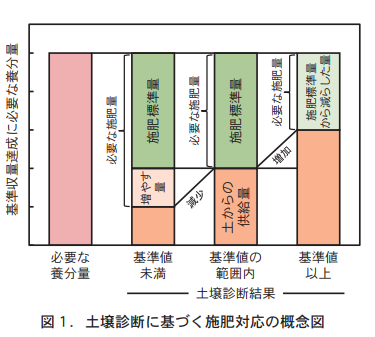
したがって,土の養分が土壌診断基準値未満の場合,土からの養分供給量が減少するので,その少なくなった量は施肥標準量の他に堆肥や化学肥料で補充して増やさなければ基準収量を生産できない。逆に,土の養分が土壌診断基準値以上の場合,土から供給される養分量が増加するので,その量を施肥標準量から減らした量で十分である(図1)。「北海道施肥ガイド2020」は,上に述べたように,土壌診断結果から施肥標準量にどのくらい増やすのか,あるいは減らすのかを「土壌診断に基づく施肥対応」として具体的な数値で作物ごとに示している。参考になるだろう。